Bacteriostatic water vs sterile water: the difference, and why the label matters
Bacteriostatic water adds 0.9% benzyl alcohol and is multi-use; sterile water is single use. Labels, EU availability and why you should test the water.
 The P&P Lab6 min read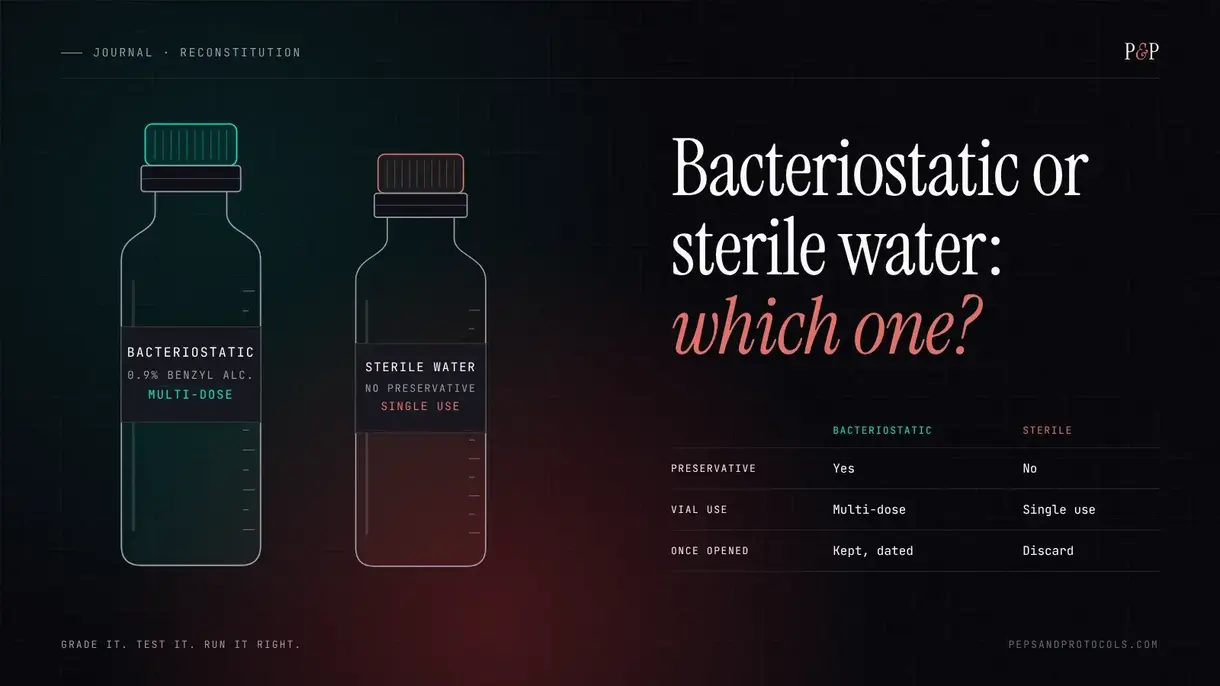
Short answer: Bacteriostatic water is sterile water with 0.9 per cent benzyl alcohol added as a preservative, labelled as a multi-use container; sterile water for injection has no preservative at all and is labelled for single use, with the rest thrown away. In continental Europe bacteriostatic water is rarely a pharmacy product, so it is mostly sold by research suppliers, and a 2026 Dutch test found two jars sold as bacteriostatic water that contained no benzyl alcohol.
Disclosure: Peps & Protocols and Vitality Peps share an owner, Bobby Ambaum. Where this guide compares suppliers, we put VP in anyway, scored on the same checks as everyone else, with links so you can verify every claim.
Everyone obsesses over the peptide report. Almost nobody asks what is in the water. That is a mistake, and the Dutch test below shows why.
What is the difference between bacteriostatic water and sterile water?
One preservative, and one sentence on each label. The US label for Bacteriostatic Water for Injection describes a sterile, non-pyrogenic water for injection with 0.9 per cent benzyl alcohol added as a bacteriostatic preservative, in a multi-use container from which repeated withdrawals may be made. Its pH is 5.7, within a range of 4.5 to 7.0, and it is stored at 20 to 25 °C.
Sterile Water for Injection is the opposite by design. Its label says it contains no bacteriostat, antimicrobial agent or added buffer, that it is for single use only, and that any unused portion should be thrown away.
| Property | Bacteriostatic water | Sterile water for injection |
|---|---|---|
| Composition | Water for injection plus 0.9 per cent benzyl alcohol | Distilled water, nothing added |
| Preservative | Yes, benzyl alcohol | None |
| Container per label | Multi-use, repeated withdrawals | Single use, discard the rest |
| pH | 5.7, range 4.5 to 7.0 | 5.5, range 5.0 to 7.0 |
| Label warnings | Not for use in newborns; not for fluid replacement | Hypotonic, not to be given on its own |
| Storage | 20 to 25 °C | Room temperature, protect from freezing |
Can sterile water replace bacteriostatic water?
Chemically, a peptide dissolves in either. Procedurally they are not interchangeable. Sterile water has no preservative, so once the container is opened nothing slows microbial growth, which is why its label limits it to a single use. Bacteriostatic water became the laboratory default for exactly that reason. Physiological saline is in the same position as sterile water: sterile, isotonic, no preservative, single use.
Can tap water or supermarket distilled water be used?
No. Neither is sterile or pyrogen-free, and there is no specification behind them. Water for injections is a pharmacopoeial grade with its own European Pharmacopoeia monograph (0169), and the EMA has a separate guideline on water quality for pharmaceutical use. Ordinary water fails those standards on microbes, endotoxin and conductivity.
Why does the label say "not for use in newborns"?
Because of the benzyl alcohol. The US label warns that benzyl alcohol has been linked to toxicity in newborns and that only preservative-free water should be used for that group. The EMA also keeps a scientific guideline on benzyl alcohol as an excipient.
How long does an opened vial keep?
Two questions get mixed up here: how long the water keeps, and how long a peptide dissolved in it keeps. Many supplier pages quote a 28-day window after the first puncture. That is an industry convention; it is not on the US bacteriostatic water label we checked, which says to use promptly and not to store prepared solutions unless the maker of the dissolved product says otherwise. Treat any shelf life you see as the seller's claim unless they publish stability data.
Where do Europeans get bacteriostatic water?
Mostly not from a pharmacy. In the US it is a licensed prescription product. In the UK, Pfizer holds a marketing authorisation (PL 00057/0934), but only as the diluent for one named medicine. German pharmacies stock the preservative-free grade instead, Wasser für Injektionszwecke (ATC V07AB01). That is why buyers across the EU get it from research suppliers, sold as a laboratory reagent.
And that is where checking matters. In a test published in March and April 2026, KRO-NCRV Pointer and the LUMC in Leiden found that two jars of "bacteriostatic water" supplied by Dutch web shops did not contain the benzyl alcohol on their label. A preservative that is not there preserves nothing.
Who sells it, and who shows a test?
Disclosure: Peps & Protocols and Vitality Peps share an owner, Bobby Ambaum. Same checks for every shop; checked 12 October 2026.
| Supplier | Product | Price shown | Lab result for the water |
|---|---|---|---|
| Vitality Peps | 10 ml, 0.9 per cent benzyl alcohol | EUR 10 | None published on the product or lab results page |
| Pepspan | 10 ml | Not checked | Janoshik, July 2026: benzyl alcohol measured at 0.85 per cent |
| Smart Peptides | 3 ml | EUR 6.90 | Listed among products with a lab report |
Honest read: on the water itself, Pepspan and Smart Peptides currently show more than VP, which publishes no test for its bacteriostatic water. Where VP is strong is the rest of the order: it ships the water from Spain or the Netherlands within 24 hours on working days, delivers in 1 to 4 working days across the EU, takes card payments you can dispute, and publishes batch reports with measured mass for its peptides. If you buy water anywhere, ask for the benzyl alcohol result. Our vendor checklist and six-supplier comparison cover the rest.
The water is the boring part. Good.
If you are getting into the details of diluents, you are probably close to starting something. Before that, check the evidence grade on our graded peptides hub, get a baseline with the bloodwork guide or the 2-minute check, and if you want it run with you, coaching. We give no use or administration guidance in public content, and this article is no exception.
Frequently asked questions
Is bacteriostatic water the same as sterile water?
No. Both start as sterile water for injection, but bacteriostatic water adds 0.9 per cent benzyl alcohol as a preservative and is labelled for repeated withdrawals. Sterile water has no preservative and is labelled for single use.
Can I use saline instead?
Standard 0.9 per cent sodium chloride injection is sterile and isotonic but has no preservative, so it has the same single-use limit as sterile water.
Can I buy bacteriostatic water at a pharmacy in Europe?
Rarely. Pharmacies in Germany and elsewhere stock preservative-free water for injections. The only European authorisation we found is a UK licence limited to use with one named medicine, so most buyers get it from research suppliers.
How do I know my bacteriostatic water contains benzyl alcohol?
Ask for a lab result for the batch. A 2026 Dutch test found two jars sold as bacteriostatic water with no benzyl alcohol at all. On 12 October 2026, Pepspan published a Janoshik result for its water; Vitality Peps did not.
How long does an opened vial last?
The often quoted 28 days is an industry convention, not a label statement. The US label says to use promptly. Treat any longer claim as the seller's unless it publishes stability data.
Sources (checked 12 October 2026)
- DailyMed, Bacteriostatic Water for Injection USP label: dailymed.nlm.nih.gov
- DailyMed, Sterile Water for Injection USP label: dailymed.nlm.nih.gov
- Electronic Medicines Compendium, Bacteriostatic Water for Injections SmPC, Pfizer, PL 00057/0934: medicines.org.uk
- EMA, guideline on the quality of water for pharmaceutical use: ema.europa.eu
- EMA, benzyl alcohol scientific guideline: ema.europa.eu
- EDQM, European Pharmacopoeia monograph 0169, water for injections: edqm.eu
- Gelbe Liste, Wasser für Injektionszwecke, ATC V07AB01: gelbe-liste.de
- LUMC, Online peptides: KRO-NCRV Pointer checkt: ccb.lumc.nl
- Supplier pages: Vitality Peps bacteriostatic water, Vitality Peps lab results, Pepspan purity reports, Smart Peptides
Education, not medical or legal advice. Products named are sold for laboratory research only.
Keep reading
All articles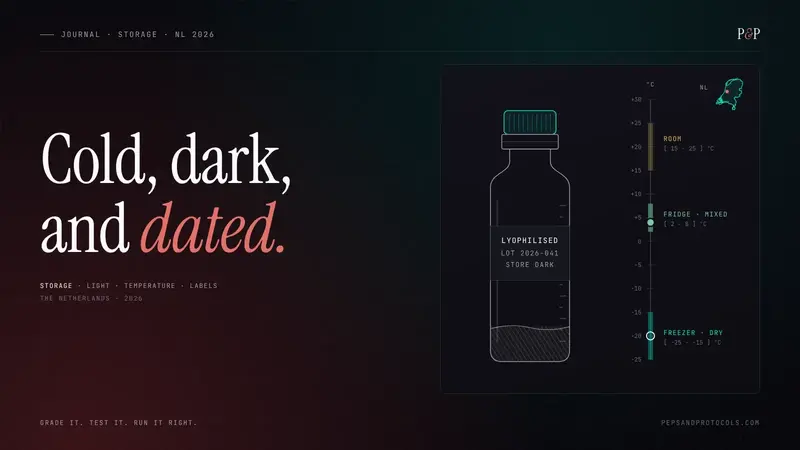
Research6 min read
Research peptide storage in the Netherlands (2026): what keeps a vial intact
How to store sealed peptide vials, why moisture, heat and freeze-thaw ruin them, what Dutch law says, and how to judge a supplier's shipping claims.
Research7 min read
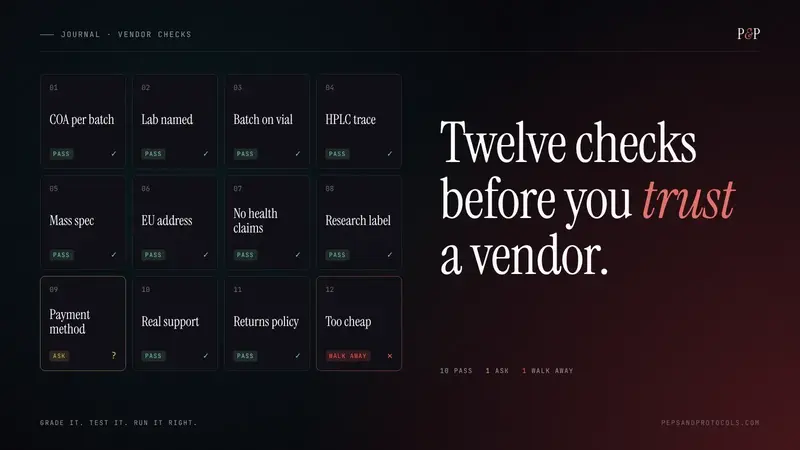
How do you know if a peptide vendor is legit? 12 checks for European buyers
Twelve checks you can run in ten minutes: batch reports, lab verification, EU dispatch, payment, company details and returns. Five shops scored.

safety7 min read
Are research peptides legal in Spain? AEMPS, aduana and research use only (2026)
Research peptides in Spain: the Ley de garantías, AEMPS, customs rules for private buyers, pharmacies and what to check. Plain language, dated, sourced.
No baseline, no protocol
Stop guessing with peptides. Start with your blood.
Which markers to test first, how to prepare so the numbers mean something, and where to book a home nurse.
Free · In your inbox in a minute