Your first peptide: a 4-week log template (and six rules)
One change, one goal, one baseline and one checked batch. Six rules, a daily log template for four weeks and clear stop signs. No doses, no hype.
 The P&P Lab6 min read
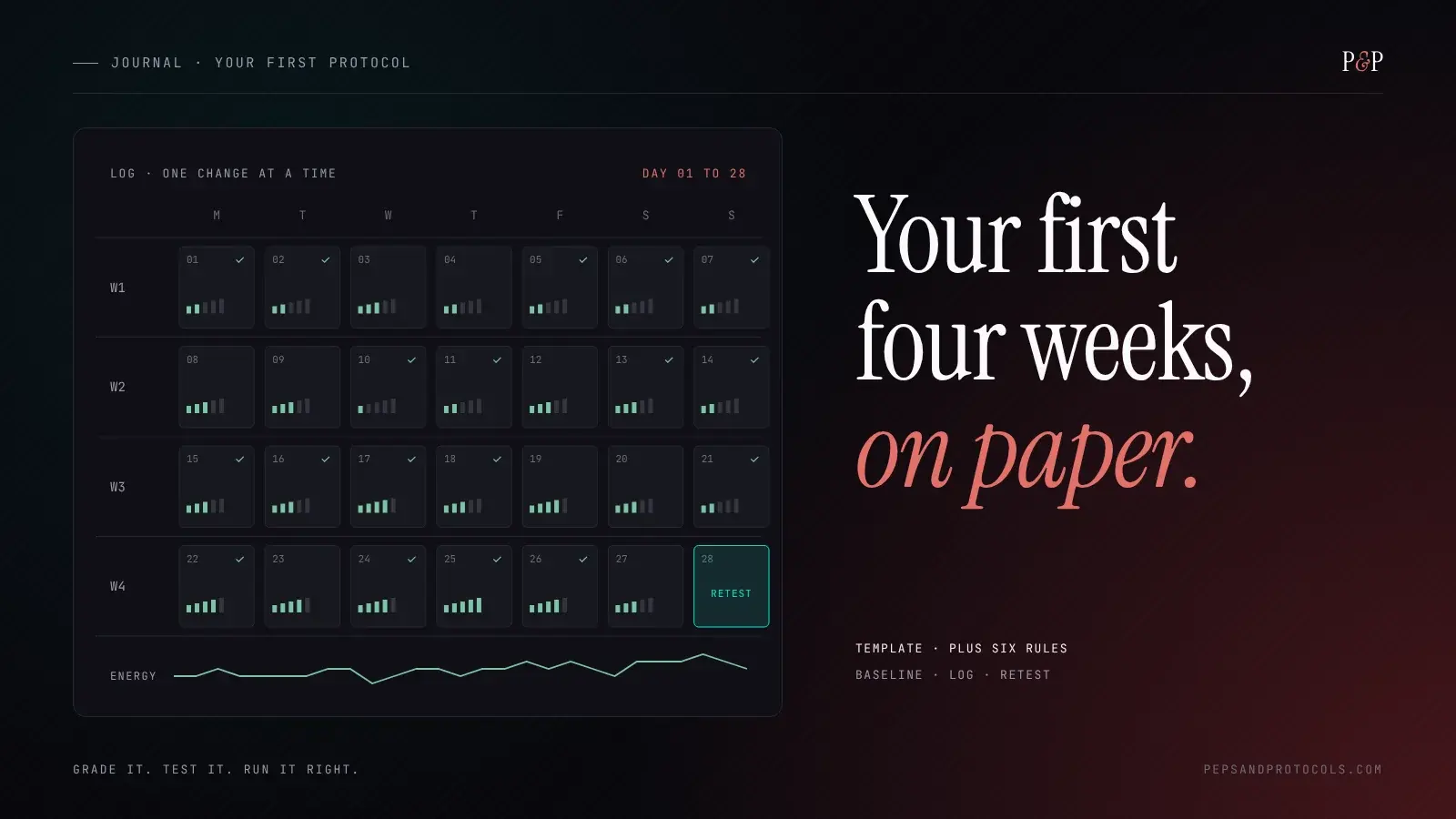
Short answer: If you are going to try a peptide, change one thing, write down a measurable goal, record a baseline (bloodwork if you can), check that the batch report matches your vial, and know your stop signs before day one. Then log every day for four weeks, change nothing else, and end with one decision: continue, change one thing, or stop.
Education, not medical advice. This is a way to keep a clean record, not a treatment plan. Peptides sold online as research chemicals are not authorised medicines in the EU, and decisions about any compound belong to you and a doctor. This article names no compound on purpose: the rules apply to all of them.
Everyone's on peptides. Almost nobody knows if theirs work. The reason is boring: no baseline, three new things at once, and a memory instead of a record. Fix that and you will know more after four weeks than most people know after a year.
Why a log, and why four weeks?
A log turns "I think it helped" into something you can check. It also protects you: if a reaction shows up, you can see when it started and what changed. Four weeks is short enough to stay disciplined and long enough to build a useful record. Start two things at once and you will never know which one helped, or which one caused the rash.
The six rules
Rule 1: One goal, written in one sentence
Write it before you order anything, and make it measurable: "less knee pain on stairs, scored 0 to 10" or "fall asleep faster, from my sleep log". That is the measure you check again at week four.
Rule 2: One change, nothing else new for four weeks
No new supplement, diet or training plan in the same window if you can help it. If life forces a change, such as illness or travel, write it in the notes.
Rule 3: A baseline, and bloodwork if you can
- Photos: same light, same distance, same time of day.
- One measure: morning weight, waist, a training number or a sleep score, taken the same way every time.
- Bloodwork: ask your GP or a lab which tests fit your goal, and book them before day one. Our bloodwork guide lists a sensible minimum panel; the bloodwork hub explains how we use it. Retest at the end if your doctor agrees.
- A week of logging first: fill in the log for seven days before you change anything. You will learn your normal ups and downs.
Rule 4: Check the batch report before day one
Labels can be wrong. In a 2026 test for KRO-NCRV Pointer, the LUMC in Leiden checked five peptides from five Dutch web shops. All five contained more active substance than the label said, some many times more. Three of five contained substances not on the label, and two jars sold as bacteriostatic water lacked the benzyl alcohol on their label.
- The batch code on your vial matches the batch code on the report.
- The lab is named and the report can be verified on the lab's own site. Janoshik, for example, verifies reports by task number and key.
- Identity is confirmed by mass spectrometry, which shows the molecule is the one on the label. Purity by HPLC tells you how clean it is, not how much is in the vial.
- Measured amount against the label: if the vial holds more than the label says, anything worked out from the label is off.
If the batch does not match, or you cannot verify the report, do not use the vial. Our 12-point vendor checklist shows how to check a shop.
Rule 5: Record exactly what you were told, and where it came from
Write the product, batch code, date opened and the plan you agreed with your doctor at the top of the log. Then write where that plan comes from, from strongest to weakest:
- the approved label of an authorised medicine;
- a published human study;
- a clinic's practice, usually with no trial behind it;
- anecdote from the internet.
If the only source is anecdote, there is no evidence behind it. Know that before day one. The evidence grade for the compound itself is on our graded peptides hub.
Rule 6: Know your stop signs before day one
- Redness that spreads, heat or pus: stop and get a same-day urgent GP appointment.
- Hives, or a swollen face, lips or throat: stop and get checked.
- Trouble breathing or a swollen throat: call 112 now.
- The batch does not match the report: do not use it.
- Anything that scares you: get checked.
Don't chase a feeling
Feeling nothing in week two is not a reason to change the plan. Many goals do not come with a feeling. Check the basics first: your measure, your sleep, food and training. Any change to the plan is a conversation with your doctor, one change at a time.
The four-week log template
One row a day, including days you take nothing. Leave a cell empty if you did not measure it; do not write 0 unless you measured 0.
| Date | Time | Taken as planned? (yes / no / missed) | Your measure | Sleep (hours, quality 1 to 5) | Any reaction (what, 0 to 10, how long) | Notes |
|---|---|---|---|---|---|---|
| 12 October 2026 | 08:00 | yes | knee 6/10 on stairs | 7 h, 3 | none | day 1 |
The example row shows the format, not a plan. Once a week, answer five questions:
- Did I stick to the plan? How many days did I miss?
- What did my measure do against the baseline?
- Did any reaction get worse week on week?
- Did anything else change: sleep, training, food, alcohol, illness?
- Did I hit a stop sign?
At week four, make one decision: continue, change one thing, or stop. Patchy records mean "inconclusive", not "keep going".
Tell your doctor
Research-chemical peptides are not authorised medicines, so your GP may know little about them. Tell them anyway. It changes how they read your symptoms and your bloodwork. Bring the log. If you want this run with you properly, graded, tested and adjusted one change at a time, that is what coaching is for. Not sure where you stand? Take the 2-minute check.
Frequently asked questions
Why only one peptide at a time?
Because you cannot tell which one did what. Start two and get a rash, better sleep or a change in your bloodwork, and you will not know which caused it. One change, everything else steady, four weeks, then decide.
Do I need bloodwork before my first peptide?
It is not required, but without it you are guessing. A baseline gives you and your doctor something to compare with. A normal result does not prove a compound is safe.
How do I check a peptide batch report?
Match the batch code on your vial to the report, verify the report on the lab's own site, and look for identity by mass spectrometry and the measured amount, not only purity. If anything does not match, do not use the vial.
What should I write in the log each day?
Date, time, whether you stuck to the plan, your measure, sleep, any reaction (what, 0 to 10, how long) and anything else that changed. Fill in a row even on days you take nothing.
I feel nothing after two weeks. Should I change something?
Not on your own. A stall is not proof that nothing is happening. Check the basics, keep logging, and discuss any change with your doctor.
Sources
- LUMC, Online peptides: KRO-NCRV Pointer checkt, 2026: ccb.lumc.nl
- Directive 2001/83/EC on medicinal products for human use: EUR-Lex
- NHS: Cellulitis: nhs.uk
- NHS: Anaphylaxis: nhs.uk
- Janoshik Analytical, report verification: janoshik.com
- Chrone VG, Lorentzen A, Højrup P. Characterization of synthetic peptides by mass spectrometry. Methods Mol Biol. 2024. PubMed 38997482
Education, not medical advice. If you think you are having a severe allergic reaction, call 112.
Keep reading
All articles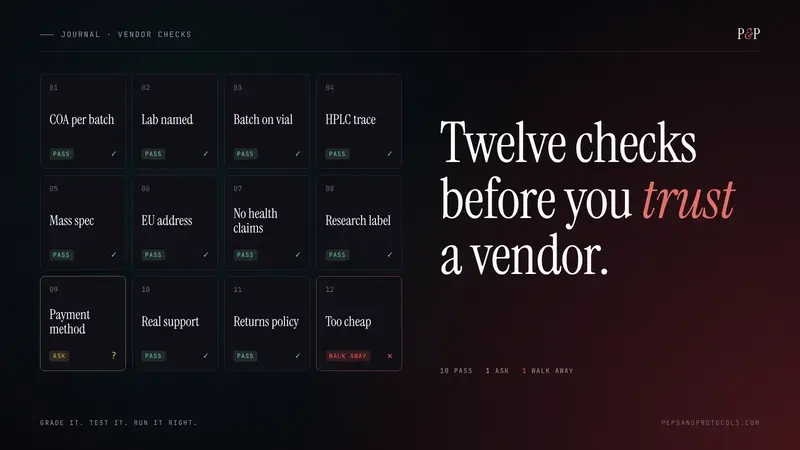
Research7 min read
How do you know if a peptide vendor is legit? 12 checks for European buyers
Twelve checks you can run in ten minutes: batch reports, lab verification, EU dispatch, payment, company details and returns. Five shops scored.

Research9 min read
Best research peptide suppliers in Europe (2026): six shops compared on checkable facts
Six EU research peptide suppliers checked on 12 Oct 2026: dispatch, batch reports, payment, returns and company details. Shared ownership disclosed.
Research7 min read
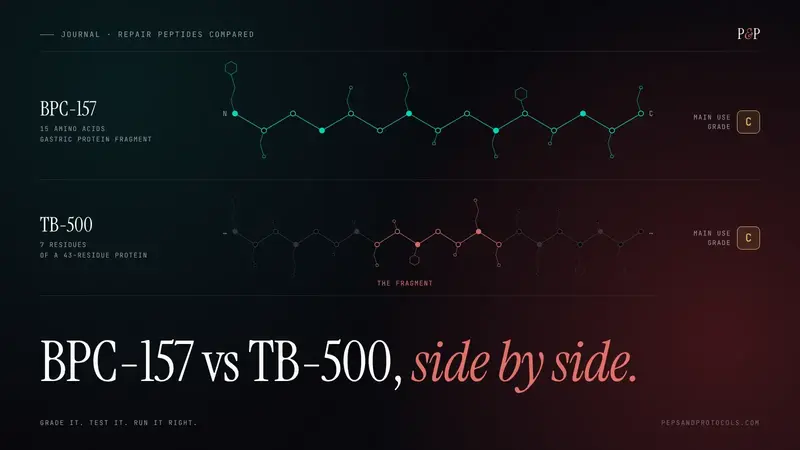
BPC-157 vs TB-500: what is the difference, and what does the evidence say?
BPC-157 is a 15 amino acid gastric peptide, TB-500 a 7 amino acid thymosin beta-4 fragment. What was studied, evidence grades, legal status and reports.
No baseline, no protocol
Stop guessing with peptides. Start with your blood.
Which markers to test first, how to prepare so the numbers mean something, and where to book a home nurse.
Free · In your inbox in a minute