What personalised metabolic research can and cannot tell us about peptide signalling
Semaglutide and tirzepatide trials show averages and variation, not personal protocols for research peptides. How to read metabolic evidence properly.
 The P&P Lab6 min read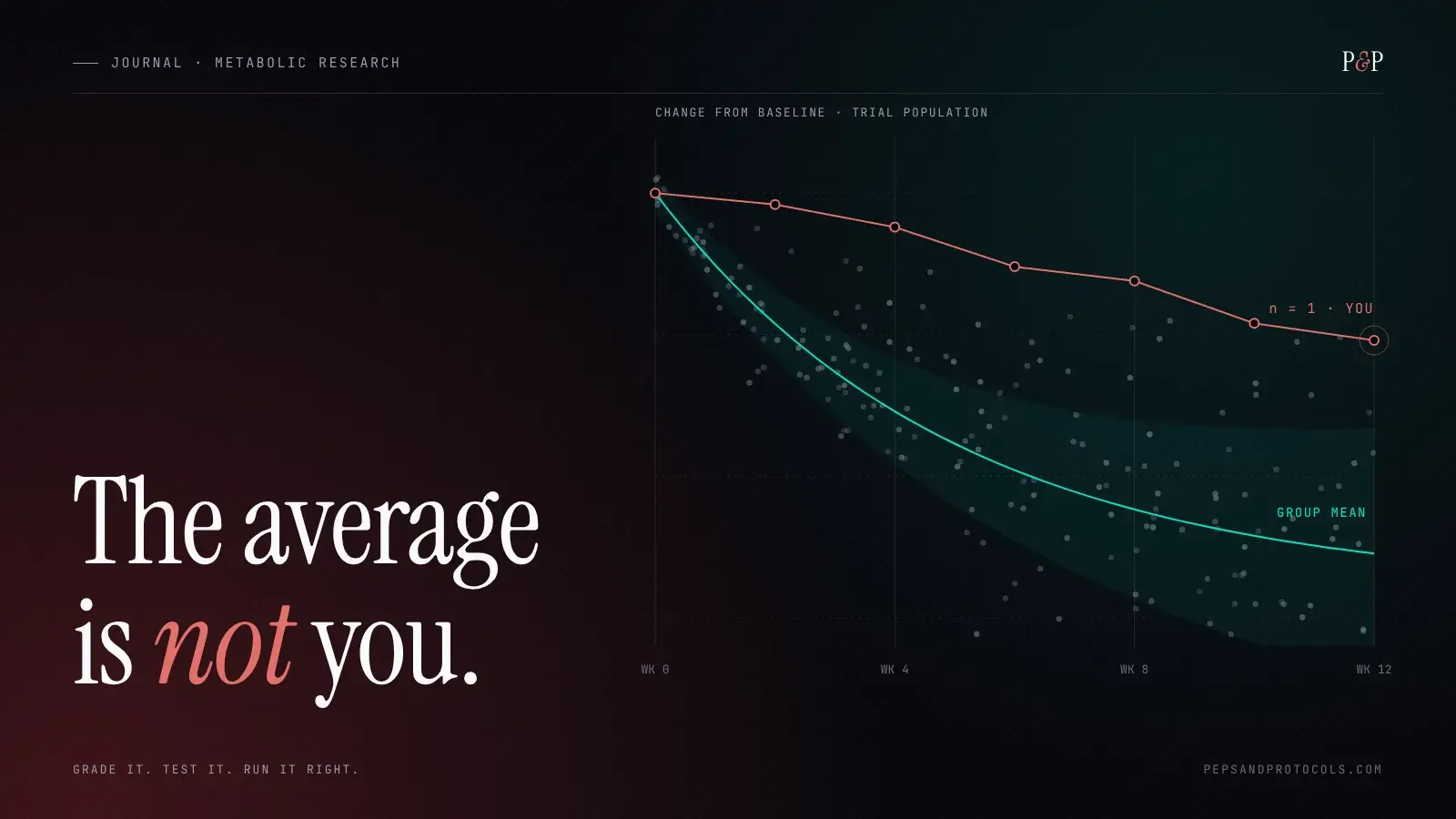
Short answer: Clinical trials of approved metabolic medicines such as semaglutide and tirzepatide show group averages and real differences between people, but they cannot justify a "personalised protocol" built on a separately made research peptide. A trial validates one product, one population and one level of oversight; a model of individual variation is a research tool, not personal guidance.
The internet has a favourite move. Take a big, well-run trial of an approved drug, borrow its results, and slap them on a research vial with a similar name and a "personalised protocol". It sounds scientific. It is not. Here is what metabolic research can and cannot tell you.
Why metabolic pathways are connected, not interchangeable
Peptide-related metabolic research looks at receptor signalling linked to appetite, blood sugar control and energy balance. Those pathways sit inside a wider system shaped by genetics, health, behaviour, environment and the conditions of each study.
Because everything is connected, it is tempting to describe a pathway as a simple lever. The published literature does not support that. Different molecules, formulations, populations and endpoints produce different results, even when they appear to act on related receptors. A pathway is a question to investigate, not a promise about your body.
What do controlled clinical trials actually establish?
Large randomised trials tested specific, regulated medicines in defined adult populations: Wilding and colleagues reported a semaglutide trial in 2021, and Jastreboff and colleagues a tirzepatide trial in 2022. On our scale those results are grade A, for those products, in those populations.
They do not validate separately manufactured research compounds, retail material or unapproved alternatives. A similar name does not mean equivalent manufacturing, formulation, quality control or legal status. A paper is not a quality certificate for material its authors never touched. Our graded peptides hub keeps that line visible: every grade belongs to one claim, one product and one population.
Is individual variation the same as a predictable personal response?
No. A 2019 review by Brown and colleagues explains why responses to some metabolic drug classes vary between people. That variation is real and worth studying. It does not mean any one person's response can be predicted accurately.
Strathe and colleagues built a model in 2023 to predict individual weight loss on semaglutide using trial data. Useful for testing hypotheses and designing studies. Its conclusions depend on the population, data quality, assumptions and the specific medicine it was built on. It is not an instruction set, and it cannot turn an unapproved material into a personalised treatment.
What actually tells you how you respond is your own data, measured before and after under proper supervision. That is why we start with bloodwork: see the bloodwork guide or the bloodwork hub.
How do study length and follow-up change the picture?
A 2022 extension of the STEP 1 trial followed people after semaglutide was stopped and documented weight regain and changes in cardiometabolic markers. One endpoint is not a whole trajectory. Follow-up length, retention, background care and the timing of measurements all shape a result, and a group average can hide wide individual spread. Short windows make bad promises.
Is a systematic review a shortcut to a personal protocol?
No. Reviews bring trials together but do not erase their differences. A 2025 review by Moiz and colleagues in the Annals of Internal Medicine noted important differences between randomised trials of GLP-1 receptor agonists for weight loss in adults without diabetes and found no direct head-to-head randomised comparisons for the products discussed. That limits what can be said about which works better. It says nothing at all about research material bought online.
Does "research use only" allow marketing for human use?
No. The US FDA has warned about unapproved GLP-1 products sold for weight management and is clear that "research use only" or "not for human consumption" wording does not fix marketing that otherwise signals human use. In the EU, a product presented for human use is a medicine under Directive 2001/83/EC and needs a marketing authorisation; regulators such as the IGJ in the Netherlands, AEMPS in Spain and BfArM in Germany act on that basis. Country detail: Netherlands, Spain, Germany and Austria.
The questions to ask instead
- Was the work done in cells, animals, an observational human group or a controlled human trial?
- Which exact product or material was studied?
- Did the authors report a group average, individual variation or a validated prediction model?
- Were the endpoints real clinical outcomes or exploratory lab markers?
- Do the manufacturing, regulatory status and study context match the claim being made?
- Has anyone else reproduced it?
Real personalisation is not a ready-made protocol. It is your own baseline, one change at a time, a retest, and a doctor where a medicine is involved. If that is the standard you want, take the 2-minute check or look at coaching.
Frequently asked questions
Can a trial result be applied to a research peptide with a similar name?
No. A trial establishes evidence for the specific regulated product, form, population and oversight in its protocol. It says nothing about the identity, purity, formulation or legal status of a separately manufactured research material.
What does individual variation in trial data actually show?
That people respond differently within the same study. It does not mean an individual's response can be predicted, and it does not support personalised protocols built on unapproved material.
Why does study length matter?
Short studies capture early responses. Longer follow-up can show plateaus or regain after stopping, as the STEP 1 extension did. The time frame is part of the evidence.
Does "research use only" labelling allow a product to be sold for human use?
No. In the EU a product presented for human use is a medicine and needs a marketing authorisation. A research-use statement does not change that.
So how do I know what works for me?
Measure. A baseline before any change, one change at a time, and a retest. Our bloodwork guide shows where to start.
Sources
- Wilding JPH et al. Once-weekly semaglutide in adults with overweight or obesity. N Engl J Med. 2021. PubMed 33567185
- Jastreboff AM et al. Tirzepatide once weekly for the treatment of obesity. N Engl J Med. 2022. PubMed 35658024
- Strathe AB et al. A model-based approach to predict individual weight loss with semaglutide in people with overweight or obesity. Diabetes Obes Metab. 2023. PubMed 37424165
- Brown E et al. Weight loss variability with SGLT2 inhibitors and GLP-1 receptor agonists. Obes Rev. 2019. PubMed 30972878
- Wilding JPH et al. Weight regain and cardiometabolic effects after withdrawal of semaglutide: the STEP 1 trial extension. Diabetes Obes Metab. 2022. PubMed 35441470
- Moiz A et al. Efficacy and safety of GLP-1 receptor agonists for weight loss among adults without diabetes: a systematic review of randomized controlled trials. Ann Intern Med. 2025. PubMed 39761578
- US FDA. FDA's concerns with unapproved GLP-1 drugs used for weight loss. fda.gov
- Directive 2001/83/EC. EUR-Lex
Education, not medical advice. This article discusses published research only and gives no treatment plans. Research materials are not authorised medicines.
Keep reading
All articles
Research7 min read
How do you know if a peptide vendor is legit? 12 checks for European buyers
Twelve checks you can run in ten minutes: batch reports, lab verification, EU dispatch, payment, company details and returns. Five shops scored.

Research9 min read
Best research peptide suppliers in Europe (2026): six shops compared on checkable facts
Six EU research peptide suppliers checked on 12 Oct 2026: dispatch, batch reports, payment, returns and company details. Shared ownership disclosed.
Research7 min read
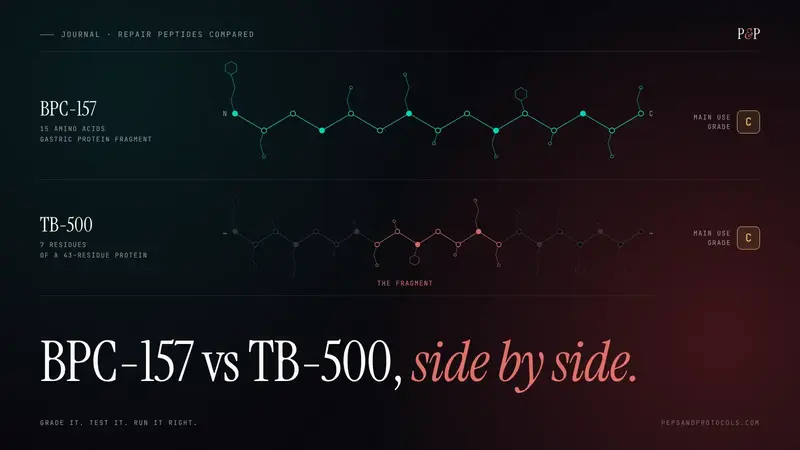
BPC-157 vs TB-500: what is the difference, and what does the evidence say?
BPC-157 is a 15 amino acid gastric peptide, TB-500 a 7 amino acid thymosin beta-4 fragment. What was studied, evidence grades, legal status and reports.
No baseline, no protocol
Stop guessing with peptides. Start with your blood.
Which markers to test first, how to prepare so the numbers mean something, and where to book a home nurse.
Free · In your inbox in a minute